
Why UAE Government Policy Changes in 2026 Are Different This Time
The UAE Government Policy Changes in 2026 are not routine administrative updates. They represent a deliberate, accelerated push by the UAE leadership to position the country as the world’s most competitive destination for talent, investment, and long-term residency — all at once.
The UAE Vision 2031 agenda, combined with the lessons learned from post-pandemic economic restructuring, has produced a policy environment in 2026 that is both more welcoming and more structured than anything the country has implemented before.
For expats living and working in the UAE, for business owners operating here, and for those considering the UAE as their next home — these changes directly affect your visa status, your taxes, your healthcare, your business license, and your long-term residency options.
This guide covers every major UAE Government Policy Changes in 2026 that has been officially confirmed and is either already in effect or coming into effect before the end of the year. Every point here is fact-checked against official government sources.
Related: UAE Labour Law Changes 2026 – 7 New Worker Rights Every Employee Must Know
Policy Change 1: Expanded Golden Visa Eligibility
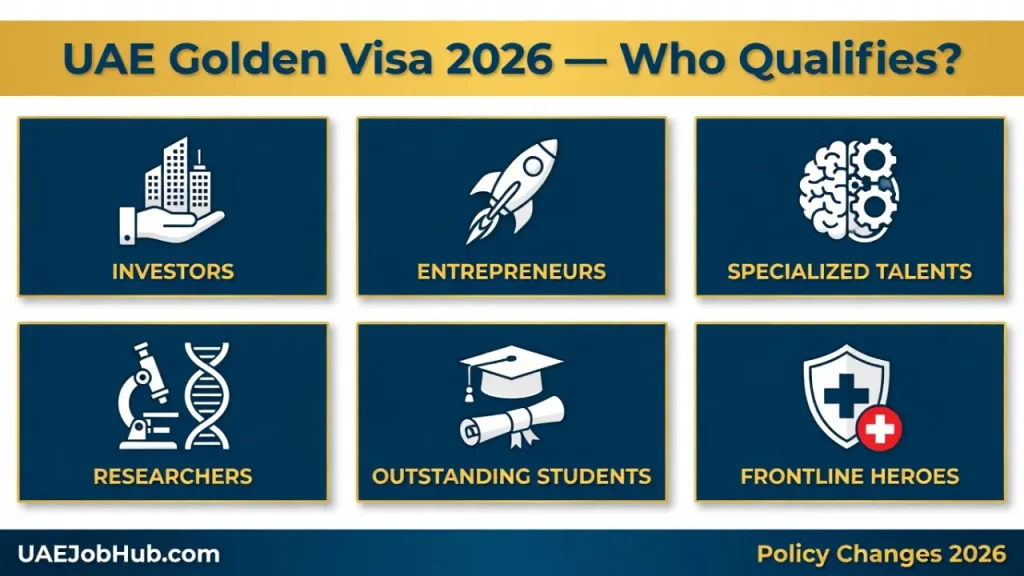
The UAE Golden Visa — the long-term residency program that grants 5 or 10-year renewable visas — has been significantly expanded in 2026, making it accessible to more people than ever before.
Who Qualifies for the UAE Golden Visa in 2026?
| Category | Key Requirement |
|---|---|
| Investors | Property investment of AED 2 million+ or business investment |
| Entrepreneurs | Approved startup with AED 500,000+ capital or incubator backing |
| Specialized Talents | Doctors, engineers, scientists, artists, athletes |
| Researchers & Academics | PhD holders, university faculty, research award recipients |
| Outstanding Students | Top graduates from UAE universities or top-ranked global universities |
| Frontline & Humanitarian Workers | Newly expanded category in 2026 |
| Skilled Professionals | Monthly salary of AED 30,000+ in select professions |
What is new in 2026?
The most significant expansion is the Skilled Professionals pathway. Previously, Golden Visa was largely limited to investors and elite talent. In 2026, experienced professionals in healthcare, technology, engineering, education, and law earning above AED 30,000 per month can now apply directly — without needing employer nomination.
Additionally, processing times have been reduced to an average of 5 working days through the ICP (Federal Authority for Identity, Citizenship, Customs and Port Security) smart platform.
Why this matters for expats: If you have been in the UAE for years building your career, 2026 is the year to check if you now qualify for long-term residency security.
External Resource: Check your Golden Visa eligibility on the official ICP UAE Portal
Policy Change 2: Stricter Emiratisation Targets for Private Sector
Emiratisation — the UAE government’s initiative to increase the participation of UAE nationals in the private sector workforce — has entered its most aggressive enforcement phase in 2026.
What Are the 2026 Emiratisation Targets?
- Companies with 50+ employees in 14 priority sectors must achieve a 10% Emiratisation rate by end of 2026
- The 14 priority sectors include: banking, insurance, financial services, IT, healthcare, retail, hospitality, real estate, construction, manufacturing, transportation, education, media, and legal services
- Companies with 20–49 employees must now hire at least 1 Emirati employee — this is a new mandatory threshold introduced in 2026
- Quarterly reporting to MoHRE is now mandatory — annual reporting is no longer sufficient
What Happens If Companies Miss Targets?
| Violation | Penalty |
|---|---|
| Missing Emiratisation quota | AED 96,000 per unfilled Emirati position per year |
| Falsifying Emiratisation records | Work permit ban + heavy fines |
| Repeat violations | Company blacklisting from government contracts |
What this means for expat employees:
This is not meant to threaten expat jobs — the UAE economy is far too dependent on skilled international talent for that. What it does mean is that hiring decisions at management and senior levels in the 14 priority sectors will increasingly factor in Emiratisation requirements. Expat professionals who develop mentorship relationships with Emirati colleagues and contribute to national talent development will find themselves in stronger positions.
What this means for job seekers from abroad:
Junior and mid-level roles in the 14 priority sectors may see slightly more competition in 2026. However, specialist, technical, and senior roles remain overwhelmingly filled by expat talent due to the current supply of qualified Emirati candidates.
Related: UAE Salary Guide 2026 – What You Should Really Be Earning by Industry
Policy Change 3: New Freelance and Self-Employment Framework
The UAE has been building its freelance economy systematically, and in 2026 the framework has matured into something genuinely functional and legally robust.
What Is New in 2026?
Freelance Permit Expansion:
- Freelance permits are now available across all 7 Emirates through a unified federal system (previously varied significantly by emirate)
- Annual cost has been standardized and reduced for several categories
- Freelancers can now sponsor their own family residence visas without needing an employer — a major shift from previous rules
Tax Clarity for Freelancers:
- Freelancers earning under AED 1,000,000 annually remain exempt from Corporate Tax registration requirements (confirmed in 2026 Federal Tax Authority guidance)
- Those exceeding this threshold must register with the Federal Tax Authority (FTA)
Health Insurance:
- Freelancers in Dubai must now hold valid health insurance to maintain their freelance permit — previously unenforced
Banking Access:
- UAE banks have been directed to improve access to business accounts for licensed freelancers — previously a significant pain point
External Resource: Apply for a UAE Freelance Permit through the official Ministry of Human Resources Tasheel Portal
Policy Change 4: Updated Tourist and Visit Visa Rules
For families of UAE residents and for those exploring the country before making a permanent move, the visit visa rules have seen important updates in 2026.
Key 2026 Visit Visa Updates:
| Visa Type | Previous Rule | 2026 Update |
|---|---|---|
| Tourist Visa (Single Entry) | 30 days | 60 days (extendable once) |
| Tourist Visa (Multiple Entry) | 90 days/180 days | 5-year multiple entry option now available |
| Visit Visa (Family of Resident) | 90 days | Extended to 180 days with one renewal |
| GCC National Visit | Visa-free | Unchanged — still visa-free |
| Job Seeker Visa | 60–90 days | Extended to 120 days in 2026 |
The Job Seeker Visa extension is particularly significant. The UAE has recognized that quality talent needs adequate time to find the right role. Extending this to 120 days gives skilled professionals from outside the UAE a more realistic window to attend interviews, complete background checks, and finalize employment contracts before visa pressure forces a departure.
Related: Latest UAE Job Vacancies 2026 – Updated Daily
Policy Change 5: Corporate Tax Compliance Expansion
The UAE Corporate Tax, introduced at a standard rate of 9% on taxable income above AED 375,000, has been in place since June 2023. In 2026, the focus has shifted decisively from introduction to compliance enforcement.
What Changed in 2026?
- Small Business Relief (available for businesses with revenue under AED 3 million) must now be formally elected each tax period — it is no longer assumed
- Transfer Pricing documentation requirements are now mandatory for businesses with related-party transactions exceeding AED 40 million
- The Federal Tax Authority (FTA) has increased audit activity significantly in 2026 — businesses in retail, hospitality, and professional services are being prioritized
- Late filing penalties have been increased — first-time late filing now carries a minimum penalty of AED 10,000 (up from AED 5,000)
- Free zone businesses that previously benefited from 0% tax must now carefully document that their income qualifies as “Qualifying Income” — the FTA is auditing free zone entities more rigorously
For employees: Corporate tax does not directly apply to your personal salary. Your income as an employee remains tax-free in the UAE regardless of these changes. However, businesses under tax pressure may make different decisions about hiring, salary increases, and bonuses — so staying informed is worthwhile.
Policy Change 6: Mandatory Health Insurance Updates
Health insurance in the UAE has historically been mandatory in Dubai and Abu Dhabi but inconsistently enforced in other emirates. In 2026, this is changing at a federal level.
2026 Health Insurance Policy Updates:
- Sharjah has moved to mandatory employer-provided health insurance for all full-time employees effective Q1 2026
- Ajman, Ras Al Khaimah, Fujairah, and Umm Al Quwain are in phased rollout — expected full compliance requirement by Q4 2026
- Minimum coverage standards have been updated federally — any policy must now cover emergency care, hospitalization, and basic outpatient visits at a minimum
- Domestic workers must now be provided health insurance by their sponsors — enforcement is being actively pursued
- Employees can now port their health insurance when switching jobs, with a 30-day grace period maintained during transitions
What this means practically: If you are moving to any emirate in the UAE, employer-provided health insurance is rapidly becoming universal. Always verify your health insurance terms during employment negotiations — do not assume coverage details.
Policy Change 7: New Data Privacy and Digital Security Law
The UAE Personal Data Protection Law (PDPL) — Federal Decree-Law No. 45 of 2021 — entered its full enforcement phase in 2026 after a grace period for businesses to comply.
What Does This Mean in 2026?
- All businesses operating in the UAE that handle personal data of UAE residents must now have a formal data protection policy
- Companies with large-scale data processing must appoint a Data Protection Officer (DPO)
- Individuals now have the legal right to:
- Request access to their personal data held by a company
- Request correction or deletion of inaccurate data
- Withdraw consent for data processing
- Cross-border data transfers to countries without adequate data protection are restricted
- Penalties for non-compliance range from AED 50,000 to AED 5,000,000 depending on severity
For job seekers and employees: This law directly protects the personal data you share with employers and recruitment agencies — your CV, passport copy, bank details, and biometrics. If a company misuses your data, you now have a legal avenue to report it.
Policy Change 8: Real Estate Ownership Rules for Expats
The UAE has always had designated freehold zones where expats could own property. In 2026, these zones have been expanded in Abu Dhabi, Sharjah, and Ras Al Khaimah — bringing more areas into expat ownership eligibility.
Key 2026 Real Estate Updates:
| Emirate | Update |
|---|---|
| Abu Dhabi | New freehold zones added in Yas Island expansion and Saadiyat Island residential districts |
| Sharjah | Expanded usufruct ownership (99-year lease ownership) to new areas |
| Ras Al Khaimah | New freehold zones opened as part of Al Marjan Island and Al Hamra development expansion |
| Dubai | Existing framework maintained; stricter off-plan developer regulations introduced |
Important for property-linked Golden Visa applicants: The expanded freehold zones mean more properties now qualify for the AED 2 million Golden Visa investment threshold — opening long-term residency options in more locations.
Policy Change 9: Education Policy and Student Visa Updates
The UAE has been aggressively positioning itself as a global education hub, and the 2026 education policy changes reflect that ambition directly.
Student Visa Updates in 2026:
- Student visa duration has been extended to match the length of the academic program — no more annual renewals for multi-year degree programs
- Students graduating from UAE universities can now apply for a 1-year post-study work permit to seek employment — a brand new pathway introduced in 2026
- Scholarship holders at UAE federal universities now receive automatic residency status for the scholarship duration
- Students from the UAE studying abroad who return can now apply for re-entry residency more easily through a simplified process
Tuition Fee Transparency:
- A new federal regulation requires all private universities and schools operating in the UAE to publish their full fee structure publicly — hidden or surprise fees are now legally prohibited
Related: Expat Guide – How to Move to UAE in 2026: Visa, Job, Housing & Cost of Living
How These Policy Changes Affect Jobs and Employment in UAE
Every one of these UAE Government Policy Changes in 2026 has a direct or indirect impact on the job market:
| Policy Change | Job Market Impact |
|---|---|
| Golden Visa Expansion | Attracts more senior talent; increases competition at top levels |
| Emiratisation Targets | Creates Emirati-focused roles; opens mentorship opportunities for expats |
| Freelance Framework | Opens self-employment legally; more project-based work available |
| Corporate Tax Enforcement | May affect bonus structures in some companies |
| Health Insurance Universality | Improves quality of employment across all emirates |
| Student Post-Study Permit | New pipeline of graduate talent entering the job market |
The overall direction is clear: the UAE wants more talent, more legally protected workers, more entrepreneurs, and more long-term residents — and the 2026 policies are designed to make all of that happen simultaneously.
Frequently Asked Questions (FAQs)
Can I apply for a UAE Golden Visa in 2026 without being sponsored by an employer?
Yes. The 2026 Golden Visa framework includes multiple self-sponsored pathways — including skilled professionals earning AED 30,000+ per month, investors, entrepreneurs, and specialized talents. You do not need employer sponsorship to apply. Applications are processed through the ICP (Federal Authority for Identity, Citizenship, Customs and Port Security) portal or through approved UAE typing centers.
How does the 2026 Emiratisation policy affect my job as an expat in the private sector?
Emiratisation targets in 2026 primarily affect companies at the organizational level — they must meet hiring quotas or pay penalties. For individual expat employees, the direct impact is mainly at the hiring decision level for certain roles in 14 priority sectors. Specialized, technical, and senior-level expat professionals remain in strong demand. The policy is designed to add Emirati talent to the workforce — not to replace skilled expats.
Is personal income still tax-free in UAE in 2026 despite the Corporate Tax?
Yes, absolutely. The UAE Corporate Tax applies to business profits — not to personal salaries or employment income. Individuals working as employees continue to enjoy a completely tax-free salary in the UAE in 2026. The 9% corporate tax only applies to businesses earning above AED 375,000 in taxable profit.
What is the new post-study work permit in UAE and how do I apply?
The post-study work permit was introduced in 2026 for graduates from UAE-accredited universities. It allows fresh graduates to remain in the UAE for up to 12 months after graduation to seek employment. Applications are made through the General Directorate of Residency and Foreigners Affairs (GDRFA) or ICP portal, supported by your graduation certificate and university attestation.
Which emirates now require mandatory health insurance for employees in 2026?
As of 2026, Dubai and Abu Dhabi have long-standing mandatory health insurance requirements. Sharjah introduced mandatory employer health insurance in Q1 2026. The remaining northern emirates — Ajman, Ras Al Khaimah, Fujairah, and Umm Al Quwain — are in a phased rollout expected to reach full compliance by Q4 2026. Always confirm your coverage before signing any employment contract in any emirate.
Final Thoughts
The UAE Government Policy Changes in 2026 tell a coherent story: this country is not slowing down. If anything, it is accelerating — deliberately engineering a future where world-class talent wants to come, stay, and build their lives here.
Whether you are an expat planning to plant deeper roots, a professional evaluating a UAE job offer, a student considering a UAE university, or a business owner navigating new compliance requirements — 2026 is a year where being informed directly translates to better decisions and better outcomes.
At UAE Job Hub, we track every policy update that affects working professionals and job seekers in the UAE — so you never get caught off guard.