
Why UAE Labour Law Changes 2026 Matter
If you work in the UAE — whether you are an expat on a work visa or a long-term resident building your career — the UAE Labour Law Changes 2026 directly affect your paycheck, your job security, and your end-of-service benefits.
The UAE has been on a mission over the past few years to modernize its labor market. In 2026, the Ministry of Human Resources and Emiratisation (MoHRE) has rolled out a series of amendments and enforcement upgrades that are among the most significant the country has seen in over a decade.
These are not minor paperwork updates. We are talking about real, enforceable changes that affect how your gratuity is calculated, whether your employer can terminate you unfairly, how overtime is compensated, and whether flexible work is actually your legal right.
This guide breaks it all down clearly — no legal jargon, no fluff — just exactly what you need to know.
Related: Complete Expat Guide to Working in UAE – Everything You Need Before You Land
What Is the UAE Labour Law and Who Does It Cover?
The UAE Federal Decree-Law No. 33 of 2021 — commonly referred to as the UAE Labour Law — is the foundational legislation governing employment relationships in the private sector across the United Arab Emirates. It was introduced to replace the older Labour Law (Federal Law No. 8 of 1980) and came into effect in February 2022.
In 2026, the government has introduced further amendments and implementing regulations under this decree-law, strengthening several provisions.
Who does it apply to?
- All private sector employees in the UAE
- Expatriate workers on UAE residence/work visas
- Part-time, full-time, remote, and flexible workers
- Domestic workers (under a separate but related framework)
Who is NOT covered under this law?
- Federal and local government employees (covered by separate civil service laws)
- Members of the UAE Armed Forces
- Workers in DIFC (Dubai International Financial Centre) — covered by DIFC Employment Law
Important: If you work in a free zone, you are generally still covered by UAE Federal Labour Law unless your free zone has its own specific employment regulations (like DIFC or ADGM).
7 Major UAE Labour Law Changes 2026
Change 1: Updated Gratuity Calculation Rules
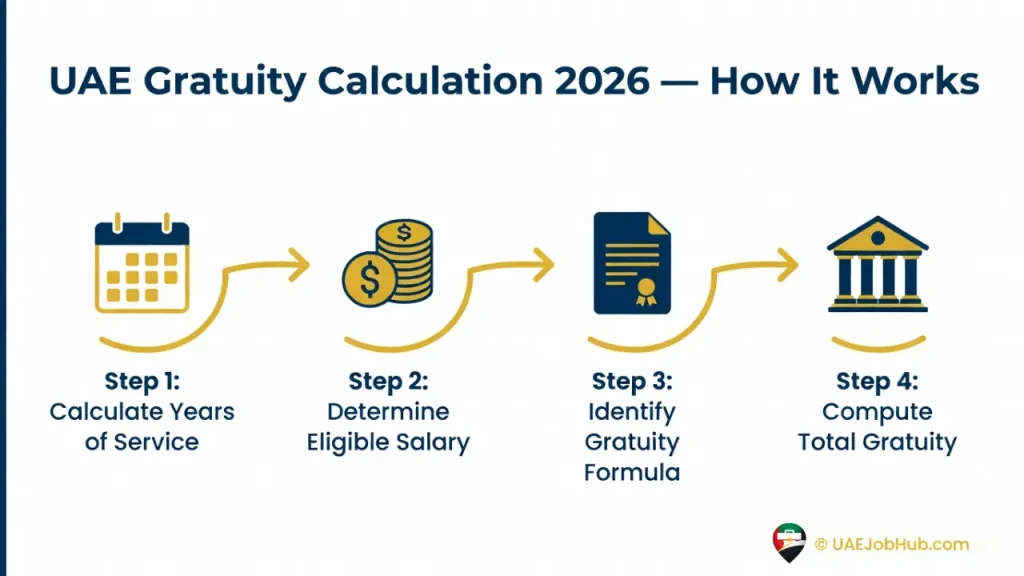
UAE Labour Law Changes 2026 have introduced clarifications and updates to how end-of-service gratuity (EOSG) is calculated — one of the most searched topics by expat workers in the country.
Here is how gratuity works under the current 2026 framework:
| Years of Service | Gratuity Entitlement |
|---|---|
| Less than 1 year | No gratuity |
| 1 to 3 years | 21 days’ basic salary per year |
| 3 to 5 years | 21 days’ basic salary per year |
| More than 5 years | 30 days’ basic salary per year |
Key 2026 Update: The MoHRE has tightened enforcement around employers who deliberately structure salaries to minimize gratuity payouts — particularly those who inflate allowances while keeping basic salary artificially low. Employees can now formally challenge this structure through MoHRE’s online dispute resolution portal.
Additionally, the gratuity cap (which limits total gratuity to no more than two years’ total wage) remains in place, but the definition of “wage” for calculation purposes has been slightly expanded to include certain regular allowances that were previously excluded.
Pro Tip: Always keep a copy of your employment contract, salary certificate, and pay slips. These are your primary documents in any gratuity dispute.
Related: UAE Salary Guide 2026 – What You Should Really Be Earning by Job Role
Change 2: Flexible Work Arrangements Now Legally Protected
This is one of the most progressive UAE Labour Law Changes 2026. The flexible work framework, which was introduced in principle back in 2022, has now been given much stronger legal backing with clearer implementation guidelines.
What flexible work types are now legally recognized?
- Part-time employment — Multiple employers, prorated benefits
- Remote work / Work from home — Formal contract terms required
- Temporary contracts — Fixed-term with defined deliverables
- Freelance/self-employment — Via UAE freelance permit system
- Shared employment — One employee, two employers sharing cost
What changed in 2026? UAE Labour Law Changes 2026
Employers are now legally required to:
- Provide written documentation of the flexible work arrangement
- Clearly define working hours, deliverables, and compensation
- Ensure part-time workers receive prorated gratuity and leave
Previously, many employers exploited the vagueness of flexible arrangements to deny benefits. That loophole has been significantly closed.
Change 3: Stricter Wage Protection System (WPS) Enforcement
The Wage Protection System (WPS) — the electronic salary transfer system that ensures employees are paid on time — has received a major enforcement upgrade in 2026.
What is new in 2026?
- Employers with 50 or more employees who delay salaries by more than 10 days now face immediate work permit freezes — faster than before
- Employers with repeated WPS violations face escalating fines starting at AED 50,000 per violation
- New in 2026: Employees can now report WPS violations directly through the MoHRE Smart App with real-time case tracking
- Domestic workers are now being progressively brought under a WPS-adjacent monitoring system
Why this matters for you: If your employer consistently pays late, this is not just inconvenient — it is now a legally actionable violation with real consequences for them.
External Resource: You can verify your salary payment status and file complaints at the official UAE Ministry of Human Resources and Emiratisation (MoHRE) portal.
Change 4: New Anti-Discrimination Protections
The UAE has historically been progressive in many areas but has faced criticism for gaps in anti-discrimination law in the workplace. 2026 marks a turning point.
Under the updated framework, employers are explicitly prohibited from discriminating against employees on the basis of:
- Race or nationality
- Gender
- Religion
- Disability status (newly strengthened)
- Pregnancy or maternity (newly strengthened)
- Age (partially addressed)
What is new in 2026?
The most significant addition is the strengthened protection for pregnant employees. Terminating a female employee because of pregnancy is now an explicitly stated violation — not just an implied one — and carries financial penalties for employers.
Maternity leave has also been reviewed:
| Leave Type | Duration |
|---|---|
| Maternity leave (paid) | 60 days |
| Additional maternity leave (unpaid) | 45 days |
| Paternity leave | 5 days |
Change 5: Updated Working Hours and Overtime Rules
Standard Working Hours in UAE (2026):
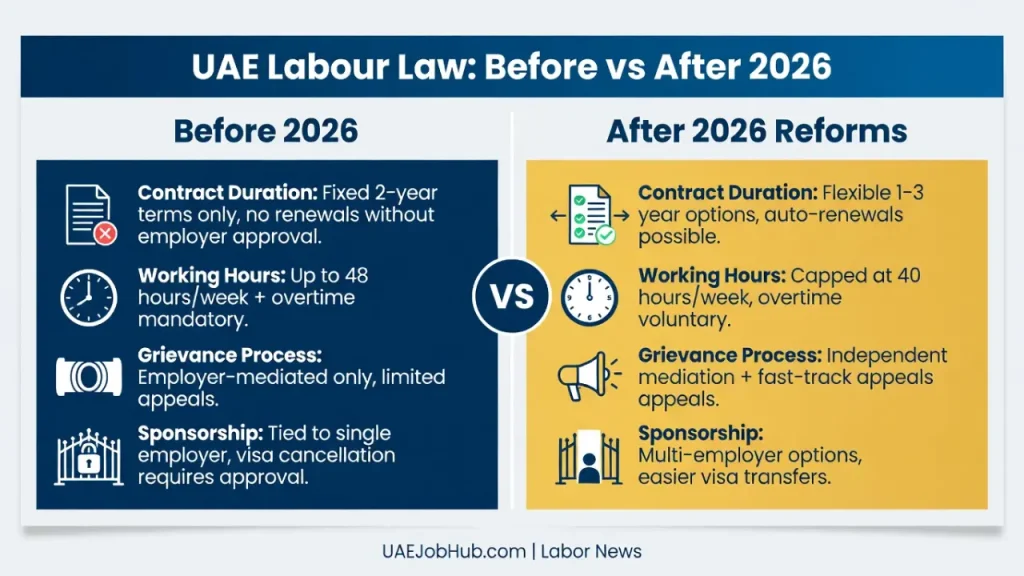
- Regular hours: 8 hours per day / 48 hours per week
- During Ramadan: Reduced by 2 hours per day for all employees
- Maximum with overtime: 2 additional hours per day (exceptions apply for certain industries)
Overtime Compensation Rates (Updated 2026):
| Time Period | Overtime Rate |
|---|---|
| Regular overtime (daytime) | 125% of hourly rate |
| Evening overtime (9PM–midnight) | 150% of hourly rate |
| Public holidays (if required to work) | Regular pay + compensatory day off OR 150% pay |
Key 2026 Change: MoHRE has introduced new guidelines requiring employers to maintain digital records of employee working hours, which must be available for inspection within 24 hours of an official request. Paper timesheets alone are no longer considered sufficient for dispute resolution.
Related: Walk-In Interview UAE This Week – Latest Job Vacancies 2026
Change 6: Stronger Protections Against Arbitrary Dismissal
Being fired without proper reason or notice is one of the biggest fears any employee carries. The UAE Labour Law Changes 2026 have tightened the rules around termination significantly.
Valid reasons for termination remain:
- Performance issues (documented, with prior warnings)
- Redundancy (with proper compensation)
- Gross misconduct (specific categories defined in law)
What changed in 2026?
- Employers must now provide a written explanation for termination at the time of dismissal
- The arbitrary dismissal compensation (separate from gratuity) has been updated — employees unfairly dismissed can now claim up to 3 months’ full wage as compensation
- Employees on probation (maximum 6 months) must now receive 14 days’ written notice before termination — previously this was not clearly mandated
- Notice periods for post-probation employees:
| Contract Duration | Minimum Notice Period |
|---|---|
| Less than 5 years | 30 days |
| 5 years or more | 60 days |
| Senior/specialist roles | 90 days |
Change 7: Digital Employment Contracts Now Fully Enforceable
This might seem like a technical update, but it has enormous practical impact. In 2026, digital employment contracts are fully enforceable under UAE law — meaning your offer letter or contract signed via DocuSign, Adobe Sign, or the MoHRE digital contract platform carries the exact same legal weight as a physically signed document.
What this means for employees:
- You can use digital contracts as evidence in labour disputes
- WhatsApp or email confirmations of salary changes may also be submitted as supporting evidence
- MoHRE now offers a free digital contract registration service to protect both parties
What this means for employers:
- You can no longer claim a contract is “unofficial” because it was sent by email
- Verbal promises of salary increments, if confirmed in writing (even digitally), become binding
External Resource: Register your employment contract officially at the MoHRE Digital Contract Platform
How These Changes Affect Expats in UAE
The overwhelming majority of the UAE’s private sector workforce — approximately 88.5% — consists of expatriate workers. Every single one of these UAE Labour Law Changes 2026 applies to them.
Key things expat workers must do right now:
- Review your current employment contract — Does it reflect the updated terms?
- Check your salary structure — Is your basic salary clearly defined? A low basic salary directly impacts your gratuity.
- Download the MoHRE Smart App — It is your most direct link to government labor services.
- Know your visa status connection to employment — If you are terminated, you have a grace period to find new employment. Know your rights during that period.
- Keep all documents digitally backed up — Contracts, payslips, offer letters, increment letters.
Related: New to UAE? Complete Expat Survival Guide 2026 – Visa, Job, Housing & More
What Employers Must Do Differently in 2026
If you are a business owner, HR manager, or employer in the UAE, the 2026 amendments come with real compliance obligations:
| Obligation | Deadline/Frequency |
|---|---|
| Update all employment contracts to 2026 standards | Immediate |
| Register contracts on MoHRE platform | Within 14 days of signing |
| Maintain digital working hour records | Ongoing |
| Pay via WPS on time | Monthly (within agreed pay date) |
| Provide written termination notice | At time of dismissal |
| Ensure anti-discrimination policy in writing | Required for companies 50+ employees |
Non-compliance can result in work permit freezes, fines, and blacklisting from hiring new employees.
How to File a Labour Complaint in UAE (2026 Process)
If you believe your employer has violated any of the above rights, here is exactly how to file a complaint in 2026:
Step 1: Visit the MoHRE website or download the MoHRE Smart App
Step 2: Navigate to “Worker Services” → “Labour Complaints”
Step 3: Submit your complaint with supporting documents (contract, payslips, correspondence)
Step 4: MoHRE will attempt amicable settlement first — a mediator contacts both parties within 2–5 working days
Step 5: If unresolved, the case is referred to the UAE Labour Court automatically — no additional filing needed
Step 6: Court proceedings are free of charge for employees earning below AED 20,000/month
Important: Do NOT resign before filing a complaint. Resignation can sometimes be used by employers to argue you left voluntarily, which may affect certain entitlements.
Frequently Asked Questions (FAQs) of UAE Labour Law Changes 2026
Are UAE Labour Law Changes 2026 applicable to free zone employees?
Most free zone employees in the UAE are covered under Federal Labour Law (Decree-Law No. 33 of 2021) and its 2026 updates. However, employees working in the DIFC (Dubai International Financial Centre) and ADGM (Abu Dhabi Global Market) are governed by their own separate employment laws. If you work in any other free zone — including JAFZA, DAFZA, or Sharjah free zones — federal UAE Labour Law applies to you.
How is UAE gratuity calculated if I resign before 5 years?
If you resign before completing 1 year of service, you are not entitled to any gratuity. If you resign after 1 year but before completing 5 years, you are entitled to gratuity calculated at 21 days’ basic salary for each year worked. After 5 years of continuous service, the rate increases to 30 days’ basic salary per year for all years — including the earlier ones.
Can my employer legally cut my salary in 2026 without my consent?
No. A salary reduction is considered a unilateral change to the employment contract and requires the written consent of the employee. If your employer reduces your salary without your agreement, this is a violation of UAE Labour Law. You have the right to file a complaint with MoHRE and potentially treat it as constructive dismissal.
What happens to my visa if I am terminated unfairly in UAE?
Upon termination — fair or unfair — your employer is required to cancel your work visa. However, you are granted a grace period of 60 days (for most visa types) to find new employment and transfer your visa. During this period, you remain legally in the country. You can also apply for a job seeker visa if needed, which gives you additional time.
Is the UAE Labour Law applicable to domestic workers like housemaids and drivers?
Domestic workers in the UAE are covered under a separate law — Federal Law No. 10 of 2017 — which governs their rights specifically. This includes entitlement to rest periods, annual leave, end-of-service gratuity, and protection against abuse. While they are not under the main Federal Decree-Law No. 33, they do have significant legal protections. The 2026 updates have also pushed for better WPS-style monitoring for domestic worker wages.
Final Thoughts
The UAE Labour Law changes 2026 represent a continued commitment by the UAE government to building a fair, transparent, and competitive labor market — one that attracts and retains global talent while protecting the rights of every worker, regardless of nationality or job level.
Whether you are a first-time expat arriving in Dubai, a seasoned professional in Abu Dhabi, or an employer managing a growing team — understanding these changes is not optional. It is essential.
At UAE Job Hub, we will continue to track every update from MoHRE, the Ministry of Justice, and the UAE Cabinet to keep you informed, protected, and ahead.
Explore More on UAE Job Hub:
- Latest UAE Job Vacancies – Updated Daily
- UAE Salary Guide 2026 – What Are You Really Worth?
- Expat Guide: How to Move to UAE in 2026 – Step by Step
- UAE Policy Changes 2026 – All Government Updates in One Place